Food, Medication, and Special Diets for Cats Staying in Our Cattery
Some cats walk into a cattery as if they own the place. Others need a little time to decide that this strange new holiday destination is acceptable. One thing we have learned over the years is that food can make a big difference. A change in environment is already a change for a cat. A change in food on top of that can be one change too many.
Why We Prefer Cats to Stay on Their Own Food
In our experience, keeping cats on their usual food helps things stay settled. Some cats cope well with change. Some let us know very clearly that they do not approve, often with an upset stomach, reduced appetite, or a face that suggests we have personally betrayed them. Bringing their regular food can remove one avoidable stress factor and helps us keep their routine as familiar as possible while they are away from home.
This matters even more for cats that get special food or prescription food. Urinary diets, renal diets, allergy diets, weight management food, and other prescribed or carefully selected foods are part of a cat’s daily care, not just their menu. We are prepared for all sorts of feeding arrangements, including raw food, as we have both fridge and freezer space available. If a cat needs something specific, we want them to have it.
Why Space and Separation Can Matter in Multi-Cat FamiliesWhy Space and Separation Can Matter in Multi-Cat Families
If one cat from a multi-cat family is on a special diet or medication, or if more than one cat is staying with us from the same household, a Double Condo is the best option. It gives both cats more room throughout the day, still allows access to the Semi Community Area – but because of the special design (Thanks to NatureHomes!) it lets us separate them at feeding time if needed. Other option include a Micrchip Feeder, where we have one available – but usually seperation is the better and more safe bet.
It is important to note: Cats are offered to enter the Semi-Community Area in the morning and at lunch time and their decide if their want to go. In any case, the Condo will be closed afterwards. No cat get access to food or even medication of another cat, even when their space in the daytime.
That can be very important. A cat on renal food should not have their dinner politely stolen by their companion. A cat that is pretending to have swallowed a pill should not be given the chance to hide it somewhere creative for another cat to find later. Yes, some cats are remarkably talented at this. We do check, but a setup that allows separate feeding makes things much easier and safer.
If your cat needs medication or a special diet during their stay, please let us know in advance. The more detail we have, the better we can prepare. Cats like routines, and if we can keep food and care as close as possible to what they know at home, that usually makes for a smoother stay for everyone, including the staff being judged from inside the condo.
If we need to provide food, we use Addiction Wild Island, a very high quality food that we know from experience is tolerated well. We also have Chicken & Rice available or be able to cook it, as this is often the best way for a cat to get a diet that does not upset the stomach, though this comes with an extra fee. Our recommendation is always to stay with your cat’s usual diet.
For long-stay cats, our staff also carry out weekly weight checks to make sure your cat is eating well. Cats can be stoic and will not always let us know when they are not feeling well.
Medication and Special Diets Are Part of the Care We Offer
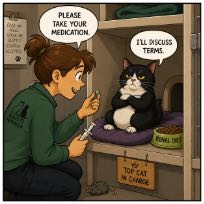
We also provide medication for cats in our care, and we know this can make a real difference for owners looking for boarding. Giving medication to cats is rarely a simple matter of “just pop in a pill”. Cats often have other opinions, and sometimes very firm ones. We use different techniques depending on the cat and the medication, including tablets, liquid medication given by mouth, and supplements mixed into food where appropriate.
Some injections can also be managed, depending on the situation. For example, diabetic cats may be suitable for boarding with us if they tolerate injections well, are stable, their dose is well adjusted and do not require ongoing blood glucose checks and dose calculations during their stay. If we feel a cat’s condition would be safer under veterinary boarding, we will say so plainly. That is not us being difficult. That is us taking the cat’s welfare seriously.